The Plowright One Health Mentoring Scheme (POMS) has launched its Online Grant Development Course, bringing together 25 early-career researchers across six teams to develop collaborative research proposals addressing interdisciplinary One Health challenges.
Running from September to November 2026, the eight-week course builds on the grant development workshop held at ILRI in Nairobi earlier this year. It provides participants with a structured opportunity to develop and test their ideas through team working, peer and mentor support, targeted learning and written feedback.
The six teams are developing proposals across a diverse range of research areas, including computational immunology, liver fluke disease mapping in Africa, fish vaccine development, African swine fever disease and recovery, antimicrobial resistance, and aerial disease risk assessment.
Throughout the course, teams will work together independently and take part in three live sessions, including a work-in-progress session and a final mock funding panel. POMS mentors will provide guidance and feedback as proposals develop.
The course aims to strengthen participants’ practical grant-development skills while encouraging teams to adopt a peer-led approach, organising themselves independently and seeking out resources, expertise and support from across the POMS network. In doing so, the course hopes both to build on existing research connections and foster new collaborations across disciplines, institutions and geographical settings.
At the end of the programme, the winning team will receive support to meet and attend an international conference together, providing an opportunity to further develop their collaboration and share their work with a wider research community.
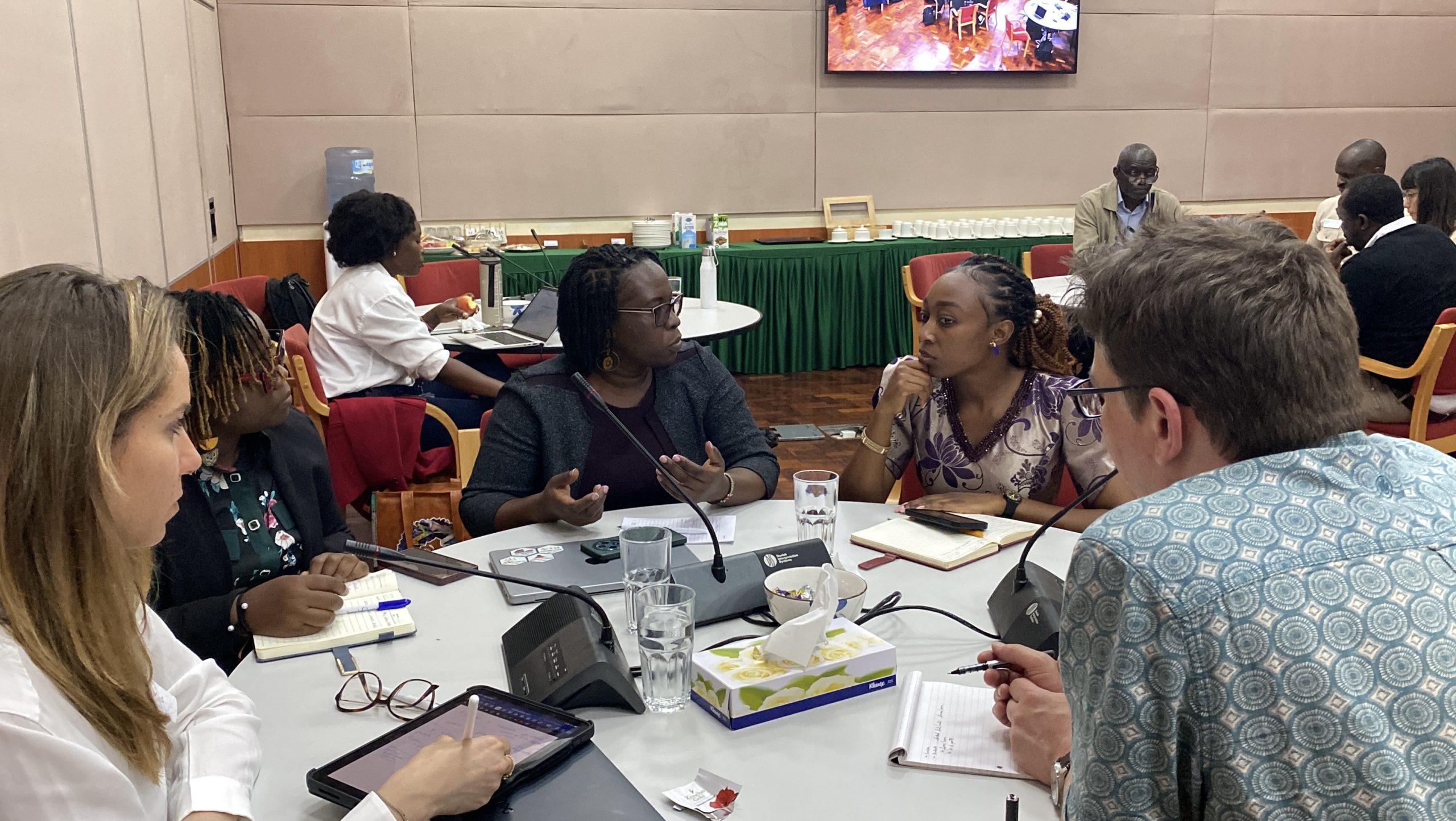
From 23 to 26 March 2026, a selection of 14 POMS mentees and 6 mentors, joined colleagues at the International Livestock Research Institute (ILRI), for a four-day grant development workshop in Nairobi, Kenya.
Participants were selected through an expression-of-interest process inviting early-stage concept notes in One Health infectious disease research, with priority given to members based regionally in Africa. Of these, 4 concepts were selected for collaborative proposal development, and remaining participants were divided into teams according to intersecting research interests.
Each team was challenged to design a proposal worth up to £3 million over 5 years, integrating at least three disciplines.The programme combined practical talks with hands-on mentor support and feedback.
Four One Health proposals
Each team was assigned a mentor who help them prepare an initial 3-slide presentation addressing what and why, how and where, and who. Teams then refined their research question, methods and partnerships in response to peer and mentor feedback. The four proposals addressed major One Health priorities across African settings:
Title
Focus
Team
WASH-POMS in sub-Saharan Africa
Animal-inclusive water, sanitation and hygiene approaches at shared human–animal water points
Oluwayomi Adeyemi, Cheikh Binetou Fall, Belinda Mligo and Ursin Bayisenge
Lassa virus surveillance in Bauchi State, Nigeria
Combining genomic, environmental and human–rodent interaction data
Yetunde Abioye, Doris Nyamwaya, Constance Agbemelo-Tsomafo and Fay Webster
Foot-and-mouth disease control in southern Africa
Using genomic surveillance to inform vaccination and control strategies
Carla Mavian, Charlie Amoia and Tshifhiwa Nefefe
Antimicrobial resistance in East and Southern Africa
Mapping transmission and drivers across human, animal and environmental systems
Melanie Hay, Ann Munene and Jean Nepomuscene Hakizimana
Specialist input
To help teams consider and apply different elements of competitive proposals, specialists talks were woven throughout the programme. Lian Thomas (ILRI), Robyn Alders (ANU, POMS) and Annie Cook (ILRI, POMS) introduced the foundations of proposal design: articulating a clear research vision, assembling interdisciplinary teams and translating ideas into connected work packages.
A second set of talks focused on the practical requirements of a fundable application. Eric Fèvre (ILRI) outlined how applications progress through eligibility checks, peer review and panel assessment, while Tim Connelley (IVVN, POMS) covered alignment with funding calls, budgets, institutional approvals and partner responsibilities.
Further specialist inputs considered how to achieve wider reach and real-world impact: Rose Chesoli (ILRI) introduced Theory of Change; Brian Perry (University of Edinburgh, POMS) examined approaches to impact assessment; Karen Wambui (ILRI) discussed identifying suitable funding opportunities for researchers in LMIC settings; Zoe Campbell (ILRI) demonstrated how gender analysis can be integrated throughout research design and implementation.
One Health in the field
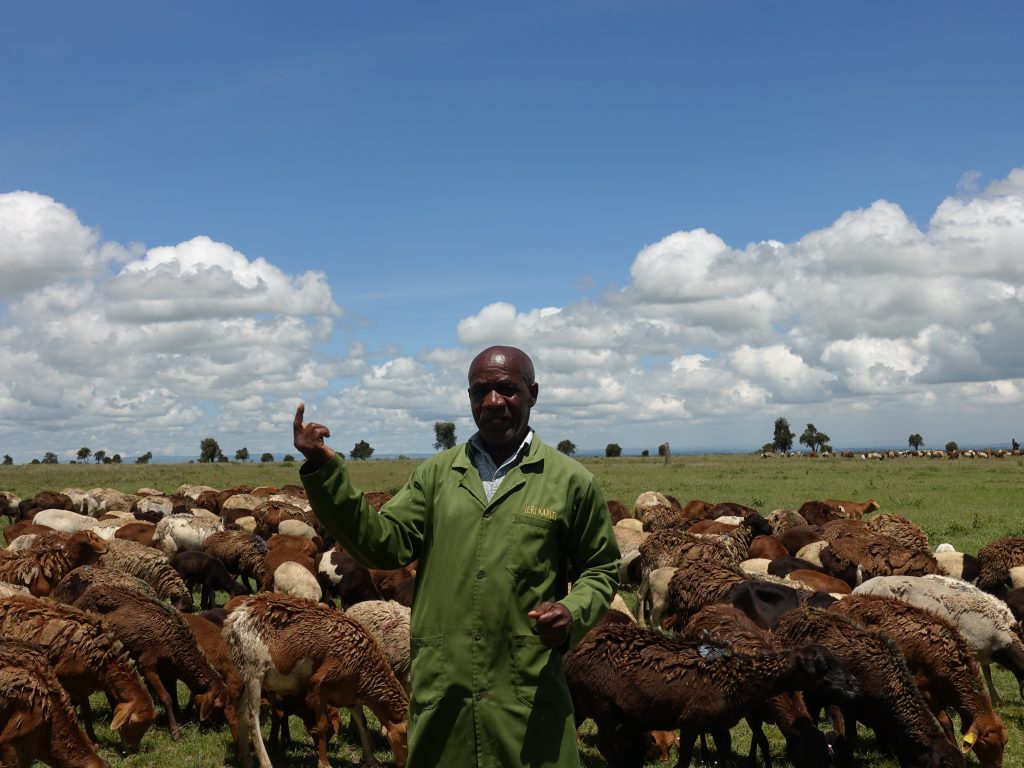
On Day 3, participants visited the ILRI Kapiti Research Station and Wildlife Conservancy, to meet those working at the wildlife-environmental interface to support sustainable livestock management and climate-resilient production
Defending final proposals
In a final mock grant panel, participants were given practical insight into formal proposal defence under conditions designed to mirror a real funding panel. Each team gave a 10-minute, 6-slide presentation followed by questions from mentors and peers, requiring participants to defend their assumptions, justify their choices and respond to criticism in real time.
What participants took away
Participants recorded excellent learning outcomes, particularly in understanding funder expectations. They also told us that their proposals changed substantially as a result of feedback and specialist input, learning to include systems mapping, stakeholder engagement, gender considerations and clearer pathways to impact. Overall, we noted a shift in focus from the narrow technical components of a proposal, those relevant to their own field, toward developing a truly interdisciplinary approach; knowing how to involve collaborators early, share ideas and planning decisions effectively and understand the value and application of outside expertise.
“I gained a new appreciation for working iteratively and sharing ideas before they feel ‘perfect’.”
Melanie Hay, POMS mentee
“I gained clarity on how to articulate interdisciplinary collaboration in a proposal. Rather than describing disciplines separately, I will now present a unified conceptual framework that shows how diverse expertise collectively addresses complex health challenges at the human-animal-environment interface.”
Charlie Amoia, POMS mentee
Reflections and next steps
In a follow-up session after the workshop, mentees and mentors considered which elements could be adapted for online delivery. They emphasised giving teams space to share ideas early and often, setting clear deadlines and milestones, and creating regular opportunities for focused mentor and peer feedback. These reflections help to inform discussions about how POMS can repeat the success of the Nairobi workshop, allowing further opportunity for small group iterative development and relationship-building across the network.
The workshop was made possible through additional support from RVC’s Official Development Assistance (ODA) fund, which supports international collaboration addressing global health, livestock productivity and disease control in low- and middle-income countries (LMIC).
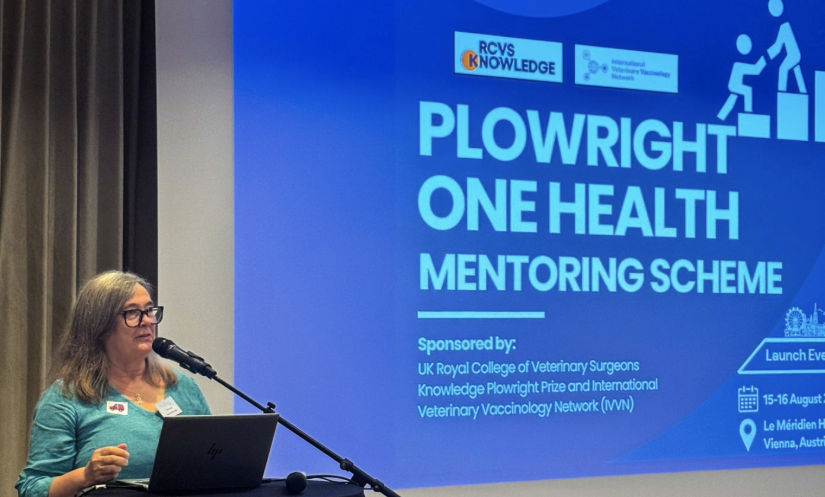
The Plowright One Health Mentoring Scheme launched in Vienna on 15 and 16 August 2025, bringing together early career researchers and One Health specialists from around the world to establish working relationships and help shape a new programme of mentoring activity.
“This first POMS cohort comprises 60 researchers (mentees and mentors) of 26 nationalities, working in high-, middle- and low-income settings. Our group is balanced in gender and diverse in age, career stage, research experience and discipline-based expertise. We want to encourage everyone to establish new professional relationships through one-to-one mentoring, group mentoring and peer mentoring.”
Professor Fiona Tomley
The event joined up current IVVN Career Development Fellows with ECRs recruited especially for POMS and introduced them to the group of experienced researchers who will be joining the programme as mentors. Professor Fiona Tomley, POMS Director, and Dr Tim Connelley, IVVN Director, opened the event by introducing the two linked programmes, their emphasis on active and equitable participation, and their shared commitment to supporting future research leaders.
Exploring One Health together
Day 1opened with speakers considering how different fields could contribute to sustainable and resilient food systems. Perspectives ranged from epidemiology, vaccinology and biotechnology to livestock health, community engagement and agribusiness, highlighting diverse framings of One Health challenges and the need for joint capacity. Senior researchers then shared their stories of career progression, collaborations and global health advocacy offering insight into the complex and often non-linear paths to One Health leadership.
A highlight of the day was the scenario-based World Café exercise on national pandemic preparedness, encouraging members to circulate, step outside their usual disciplines and consider how different forms of expertise, organisations and partnerships can work together to inform policy and practice.
A closing Q&A discussion explored the key barriers facing mentees and listened to their priorities for support through the programme.
Shaping the network
Day 2 saw the mentees begin Cultivating Confidence in Leadership, an IVVN-supported coaching programme led by Dr Margaret Collins. The opening session focused on introductions and intention-setting, with further coaching to be delivered online after the event.
At the same time, mentors met with the POMS and IVVN teams to discuss one-to-one mentoring, future online activities and opportunities for mentees to present their work and learn from one another.
The event concluded with an open discussion between mentors and early-career researchers about interdisciplinary working, research leadership and the challenges encountered during a career in One Health.
Listening to feedback
The feedback from the event was highly positive and forthcoming, identifying members’ priorities for future activities. Suggestions included opportunities to showcase members’ research, space for developing peer-led activity and access to specialist grant writing and other career-focused training.
In addition, it underlined the importance of accessibility when planning future face-to-face activities, with interest in regional events in Africa and Asia that could reduce travel and visa barriers.
The Vienna launch established a shared starting point for POMS. The ideas and priorities raised during the event have played a key role in shaping the network’s mentoring sessions and wider programme of activities.